Unmanned ground vehicles: what a border surveillance patrol covers
Unmanned ground vehicles for border surveillance exist for one reason: a machine that can be moved can be moved to see past the ridge — which is the only way to close dead ground without building a second mast. Everything else about these platforms follows from that one advantage and its cost.
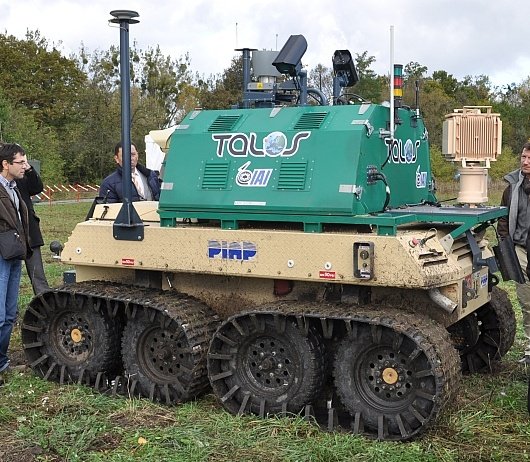
What an unmanned ground vehicle is, in border surveillance terms
Strip away the vocabulary and the platform is a chassis, a power source, a drive system, a sensor mast and a radio. Its size is set by what it must carry and where it must go, not by any theory of autonomy. The vehicles that appear in European border research sit between a large quad bike and a small tractor: big enough to raise a sensor head two or three metres and carry a day's power, small enough to move down a forestry track without widening it.
The chassis choice divides on ground rather than doctrine. Tracks spread load and cross soft, wet or broken terrain that stops wheels. Wheels are faster, quieter, cheaper to keep running and much better on the hard patrol tracks that most border routes actually follow. A programme written for a single member state can choose. One written for several usually ends up specifying both, which is one reason integrated demonstrations look less tidy than the drawings that preceded them.
What the platform carries, and what that costs it
The payload is where a border surveillance platform earns its place: a thermal channel, a daylight camera, usually a short-range radar, sometimes an acoustic head, and the processing to turn all of that into a return worth sending. Each addition costs power, and power costs endurance, and endurance is the whole argument for a mobile system in the first place.
Sensor height matters more than sensor quality once the ground is broken. Raising a head from one metre to three does more for what a platform can see across a rolling field than a generational improvement in the detector, for exactly the reasons set out under fixed masts against mobile patrols. That is why almost every platform in the record carries a mast it can extend when stationary and fold when moving.
How far an unmanned patrol actually covers
Coverage for a moving platform is a rate, not an area. The useful figure is ground observed per hour, and it is bounded by transit time rather than by sensor range. A platform that travels at eight kilometres an hour and stops for six minutes at each observation point does not cover eight kilometres of border an hour; it covers the sum of the arcs it observed while stationary, minus everything it drove past without looking.
Three figures govern the result, and only the first is usually published.
| Quantity | Set by | Typical order |
|---|---|---|
| Endurance | battery or fuel, sensor draw, terrain | 4–12 h |
| Transit speed on track | chassis, surface, autonomy mode | 5–20 km/h |
| Dwell per observation point | sensor integration, confirmation | 3–10 min |
| Communications range | relay layout, terrain, spectrum | the binding limit |
The fourth line is the one that decides most deployments. A platform that outruns its radio link stops being a surveillance asset and becomes a recovery problem, so in practice the patrol envelope is drawn by where the link holds, not by how far the vehicle could drive. Every published European trial that reported a limiting factor reported this one.
The ranges above are orders of magnitude drawn from published trial reporting, not specifications for any particular machine. They are given to show which quantity binds, which is the part that transfers between programmes.
What autonomy means for these platforms
In the European border research record, autonomy almost always means the vehicle handles the driving: following a corridor, avoiding obstacles, judging whether a slope or a patch of soft ground is passable, and returning to a point if the link drops. It does not mean the platform decides what a detection is or what to do about it. That distinction is not a technical detail; it is the line the programmes themselves drew, and it is examined under observing or acting.
The practical consequence is that autonomy changes the shape of the crew requirement for unmanned ground vehicles rather than removing it. One operator may supervise several platforms instead of driving one, but the maintenance cycle, the recovery capability and the person empowered to act on a report all remain. Published operator-to-platform ratios vary widely enough across programmes that quoting a single number would misrepresent all of them.
Where unmanned ground vehicles stop
- Soft ground and deep snow, where recovery costs more than the patrol was worth
- Dense undergrowth, which stops a ground platform long before it stops an aerial one
- Terrain without line of sight for the radio link, unless relays are built first
- Anything requiring a decision about a person, which stays with an officer
None of these is an argument against unmanned ground vehicles for border surveillance. They are the boundary conditions that decide where a mobile patrol is the right instrument and where a mast, an aerial platform or nothing at all is. A reference that omitted them would be describing a brochure rather than a border.
Questions about unmanned ground vehicles
What are unmanned ground vehicles used for in border surveillance?
Two jobs, and they pull in opposite directions. As a moving observation post a platform closes dead ground that a fixed mast cannot reach. As a first responder it goes to a detection and returns a closer look before anyone commits people to the ground. A platform optimised for the first is slow, quiet and long-legged; one optimised for the second is fast and short-legged. Programmes that specified both usually got a compromise at neither.
How much autonomy do border surveillance platforms actually have?
Less than the word suggests. In the European research record the routine mode is teleoperation or waypoint following with an operator supervising, not independent decision making. Autonomy in these programmes means the vehicle handles the driving between points — obstacle avoidance, terrain assessment, keeping to a corridor — while a person keeps responsibility for what happens on a detection. See autonomy levels for the scale.
Can an unmanned ground vehicle patrol a border on its own?
Not in any documented European deployment. Endurance, recovery when a platform fails on soft ground, the communications link, and the legal position on acting without a human all bound it. The realistic unit is a platform plus an operator plus a recovery capability, which is a smaller saving than the phrase "unmanned" implies.
Why do tracked and wheeled platforms both keep appearing?
Because ground varies more than the machines do. Tracks spread load and cross soft, wet or broken terrain that stops wheels; wheels are faster, quieter, cheaper to maintain and far better on the hard tracks that border patrol routes usually follow. Neither wins outright, so programmes covering several member states tend to specify both.