The TALOS project: FP7 border surveillance by unmanned ground units
The TALOS project for border surveillance was a four-year attempt to replace fixed installations with a supervised flock of unmanned ground platforms, funded under the EU's Seventh Framework Programme and demonstrated once, at a military training ground in Poland, in April 2012.
What the TALOS project set out to do in border surveillance
Conventional land border surveillance is built from installations placed along the whole length of a frontier and supplemented by human patrols, so its cost scales with the length of the line. The TALOS project proposed a different arrangement: sensors carried by unmanned ground vehicles with a degree of autonomy, supervised from a mobile command centre, with aerial platforms above them and — in the consortium's own phrasing — no requirement for fixed infrastructure or fences. The platforms were to serve both as observation posts and as the first unit to reach a detected crossing.
The stated design properties were scalability, mobility, adaptability and modular construction, so that a deployment could be sized to a particular stretch of border rather than built once at a fixed density. Border guards from participating states sat on an End User Advisory Board, which advised on requirements without commissioning anything.
The consortium also drew a limit on its own system, in public, in terms worth recording precisely because it is the limit such programmes are judged against: the vehicles were to observe, detect and inform, and to take no action affecting a person's health or life. What that line means in practice, and what keeps it in place, is examined separately under observing or acting.
Who built it, and the FP7 unmanned ground platform
| Organisation | Country | Role in the project |
|---|---|---|
| PIAP | Poland | Coordination; UGV low-level control and navigation; cooperation with Polish Border Guard |
| ASELSAN | Turkey | Top-level system architecture; command and control subsystem |
| Israel Aerospace Industries | Israel | Technical management; UGV design; user training |
| Hellenic Aerospace Industry | Greece | Command posts and shelters; deployment and validation |
| ONERA | France | Optical sensors: definition, modelling, characterisation, test |
| VTT | Finland | Virtual prototyping; 3D terrain modelling; field validation |
| Warsaw University of Technology | Poland | Communication and navigation research; dissemination |
| ITTI | Poland | User requirements and IT system design |
| Telekomunikacja Polska | Poland | Communication system and services |
| Smartdust Solutions | Estonia | Operator control unit software, embedded |
| STM | Turkey | Architecture and command and control implementation |
| TTI Norte | Spain | Communications design, reception while moving |
| European Business Innovation & Research Center | Romania | Commander and UGV operator control unit software |
Roles above are as the project's own partner listing described them. A thirteen-row table against a stated fourteen partners is not an omission on this page: the public listing and the headline partner count do not reconcile exactly, and this site records the discrepancy rather than silently choosing one of the two numbers.
What was actually built and shown
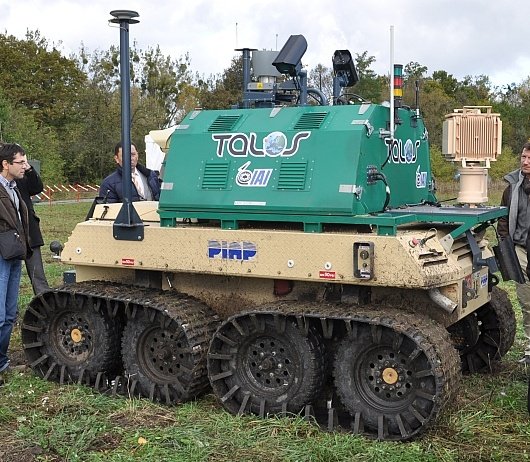
Work ran through the usual research sequence — requirements with the advisory board, architecture, subsystem development, integration, and a series of review meetings with demonstrations attached. Meetings recorded in the project's own news pages took place in Poland, Greece, Israel and Finland across the four years, each pairing a formal review with a demonstration of whatever had reached working condition.
The final demonstration was held on 17 and 18 April 2012 at the training ground of the Gen. Tadeusz Kościuszko Military Academy of Land Forces near Wrocław, Poland, under the name TALOS Demo Day. It showed the integrated system: ground platforms carrying sensor heads, a command centre, and the communications between them, on open rolling terrain of the kind the concept had been specified against. A documentary film of the project was released afterwards.
What became of the TALOS project
The project closed in May 2012, on schedule. No operational deployment of the integrated system has been recorded in any public source since, and no procurement following from it appears in the public record. That is not in itself a judgement on the work: as set out under programmes and funding, a framework programme ends at a demonstration and procurement is a separate process, with separate money, decided nationally.
Several partners continued the individual subsystems into later programmes, and the ground robotics capability at the coordinating institute remained active well beyond the project. The integrated concept — a supervised flock of ground platforms replacing fixed installations along a land border — did not continue under this name. Later European programmes returned to parts of the same idea; the ROBORDER dossier covers the closest successor.
The TALOS project for border surveillance kept its own website online for some years after the work ended, and its FP7 dissemination and its contents were subsequently lost, which is a common fate for research dissemination once the work package that funded it closes. Where this dossier cites the project's own material, it is describing what the consortium published about itself, which is a different kind of evidence from an independent assessment. No independent evaluation of the built system appears to be public.
Sources for this dossier
- Grant record and final report, CORDIS project 218081 — European Commission
- Public deliverable D1.1, formal End User Advisory Board membership
- The project's own general information, partner and news pages, as published 2009–2013
- The coordinating institute's project description
- Contemporary reporting in the technical and general press, 2011–2012
Where the grant record and the project's own material differ, the grant record is treated as authoritative and the difference is stated on the page rather than resolved silently.
Questions about the TALOS project
What was the TALOS project?
The TALOS project for border surveillance was a four-year research programme co-funded by the European Commission under the Seventh Framework Programme, security priority, grant agreement 218081. It designed, built and field tested a mobile system for watching an external land border using unmanned ground platforms supervised from a mobile command centre, rather than fixed installations along the whole length of the line.
Who ran the TALOS project?
A consortium of fourteen organisations from ten countries, coordinated by PIAP, the Industrial Research Institute for Automation and Measurements in Poland. Participants came from Belgium, Estonia, Finland, France, Greece, Poland, Romania and Spain, together with Turkey as a candidate country and Israel as an associated country.
What did the TALOS project cost?
The grant record gives a total cost of €19 497 387, of which €12 898 332 was the EU contribution. The internal split between partners is not public, which is normal for this kind of grant and is why totals can be quoted here and shares cannot.
Was the TALOS system ever deployed on a border?
No operational deployment of the integrated system is recorded in any public source. The project closed in 2012 after a final demonstration in Poland. Individual subsystems and the expertise behind them continued into later work by several partners; the integrated concept did not continue under this name.
Was TALOS designed to stop people by force?
The consortium's own public material drew the line explicitly and narrowly: the vehicles were to observe, detect and inform an intruder of their situation, and to take no action affecting a person's health or life, with border guards supervising. That is the statement the project made about itself, and it is recorded here as such rather than as a verified account of the built system.