The FOLDOUT project: detection through foliage at external borders
The FOLDOUT project and dense foliage: a programme aimed at one specific and stubborn failure mode rather than at border surveillance in general: what to do when the ground you need to watch is under trees. Its registered title names the hardest case in it — the outermost regions of the EU.
Why dense foliage defeats detection at the external borders
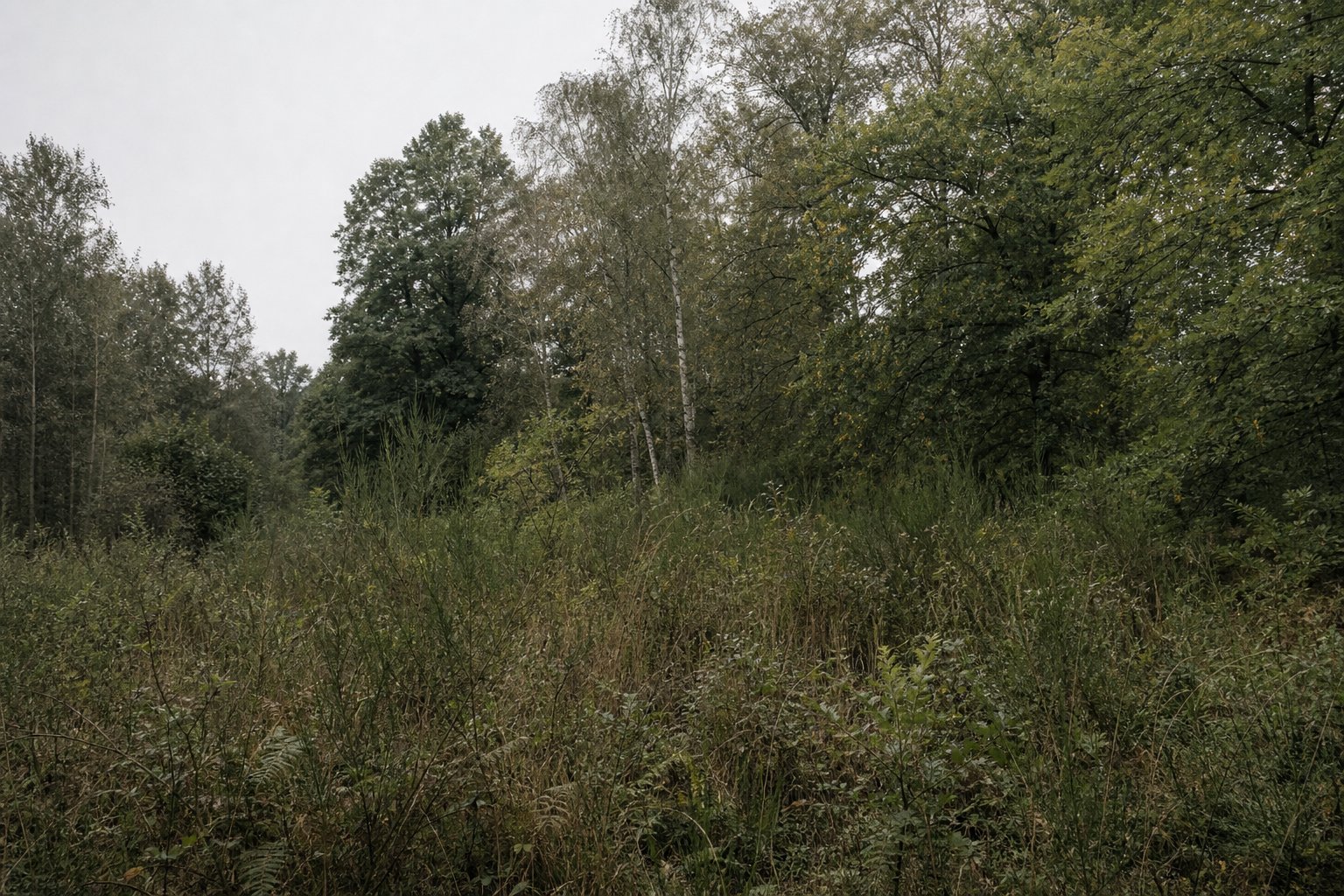
Vegetation is the case in which most of this site's other pages stop being useful, and it does so for several unrelated reasons at once. A thermal channel loses contrast because leaves absorb and re-radiate; the canopy is a warm surface between the sensor and anything under it. An optical channel sees the canopy and nothing else. Radar returns clutter from every leaf moving in wind. And an aerial platform, which exists precisely to look over obstructions, is looking down at the densest part of the obstruction.
Because the failures have different causes, they do not have a common fix. That is what made this worth a dedicated programme rather than a work package inside a larger one.
The part that is easy to miss: foliage is seasonal
A coverage figure measured in March is not the coverage available in July. Deciduous canopy can remove a large part of an installation's observed arc between one month and the next without anything in the equipment changing, and restore it again in autumn. Nothing in a specification captures this, and nothing in a single field trial does either unless the trial deliberately spans seasons.
It compounds a problem already described under fixed masts against mobile patrols. Dead ground created by terrain is permanent and can at least be surveyed once. Dead ground created by vegetation moves with the calendar, which means an installation's real coverage is a range rather than a number — and the number that gets published is usually the one from the best month.
What was tested, and where
A two-year pilot in Bulgaria, with demonstrators in Greece, Finland and French Guiana. That spread is the right design for this question and it is the most interesting fact in the record: the four settings have almost nothing in common botanically. Bulgarian and Greek cover, Finnish boreal forest and the tropical canopy of an outermost region defeat a sensor in different ways and at different densities.
Testing in one and generalising would have produced exactly the kind of single-figure claim this site spends its time taking apart. Testing in four is also why a programme aimed at one failure mode needed 21 participants and four years.
What became of it
The programme completed and no operational deployment of the integrated system is recorded in public sources. The underlying problem has not gone away, and vegetation remains the condition in which published coverage figures and observed coverage diverge most.
What the four-site design does establish, whatever became of the integrated system, is a negative result of real value: there is no single answer to foliage. A sensing arrangement tuned to Bulgarian scrub is not the arrangement for boreal forest, and neither is the arrangement for tropical canopy — not because one is better engineered, but because the obstruction has different density, different water content and different thermal behaviour in each. Any product claiming to solve detection through vegetation as a general problem is claiming something this programme's own design assumed to be false.
The seasonal point in the FOLDOUT project and dense foliage has a practical consequence that outlives the programme. Because canopy coverage varies through the year, an installation's real performance can only be stated as a range with the months attached, and almost no published figure is stated that way. A reader comparing two systems on their quoted numbers is, in wooded terrain, frequently comparing one system's best month with another's, without either document saying so. There is no way to correct for it after the fact; it has to be asked for at the point the figure is given.
The outermost-region site is the part of the FOLDOUT project record most likely to be under-appreciated. A European external border is usually pictured as a line in continental Europe, and the legal definition is wider than that — which is set out under what counts as an external land border. Testing in French Guiana was not an exotic addition to the programme. It was a European external border with the hardest vegetation in the set.
Sources for this dossier
- Grant record, CORDIS project 787021 — European Commission
- Public deliverables of the programme
- The consortium's own published description of the trials
One figure in the record is worth noting rather than smoothing over: total cost and EU contribution are recorded as the same number, €8 199 388, meaning the work was funded in full rather than co-funded. That is unusual enough among the programmes profiled here to be stated rather than left for a reader to notice.
Questions about the FOLDOUT project
What problem was the FOLDOUT project built for?
Vegetation. The FOLDOUT project addressed detection under it, because every sensing method described on this site degrades in dense foliage, and several stop entirely: thermal contrast is absorbed by leaves, optical channels see canopy, and an aerial platform looking down at woodland sees the top of it. FOLDOUT addressed that one problem rather than border surveillance in general.
Why is foliage such a hard case?
Because it defeats different sensors for different reasons, so no single alternative channel substitutes for the others. It also grows: coverage measured in March is not coverage in July, and a system commissioned in winter can lose a large part of its arc without anything in it changing.
Does a ground platform solve the foliage problem?
Partly, and it introduces its own. Under a canopy a ground platform can see what an aerial one cannot, which is why the two are usually specified together. But dense undergrowth stops a ground platform physically long before it stops an aerial one — see unmanned ground vehicles.
Where was FOLDOUT actually tested?
A two-year pilot in Bulgaria, with demonstrators in Greece, Finland and French Guiana. The four settings share almost no botany: Balkan and Mediterranean cover, boreal forest and the tropical canopy of an outermost region. That spread is the point — a through-foliage technique proven in one of them says nothing about the others.
Was anything from FOLDOUT deployed?
No operational deployment of the integrated system is recorded in public sources. As with the other programmes profiled here, the work ended at demonstration.