The command and control centre: what operators hold, and the handover
Every sensor on a border eventually resolves into one question asked of one person: is this worth acting on. A command and control centre in border surveillance is where that question arrives. The command and control centre is where that question is asked, and it is the part of the system least described in public.
What a command and control centre in border surveillance does
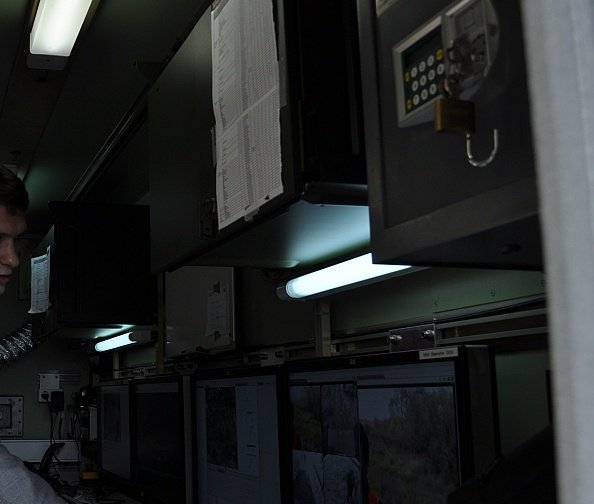
Descriptions of border surveillance usually stop at the sensor. The command and control centre is where the returns become something a person can act on, and it does four separable jobs. It holds a current picture of a stretch of border. It correlates what arrives, either by machine or by operator. It decides what warrants a response and dispatches it. And it records the whole sequence in a form that can be reconstructed later.
The last job is the one that is under-specified almost everywhere and the one that matters most after the fact. A detection that led to an action, and an action that is later questioned, can only be examined through what the centre logged. If the log holds the decision but not the evidence behind it, the reconstruction fails.
Operators, and the real limit on span of control
How many platforms or sectors one operator can hold is a question with no fixed answer, and the published figures from European programmes vary too widely to average. What is consistent across them is where the limit comes from. It is not screen area, and it is not the number of feeds a system can display. It is interruption rate.
An operator holding six quiet sectors is comfortable. The same operator holding six sectors during a wet, windy night — when a buried line is triggering on weather and a radar is returning clutter — is holding one, badly. Span of control is therefore a function of how well the channels are correlated before they reach a person, which is why fusion is a staffing decision as much as an engineering one.
| State | Held by | Survives a handover? |
|---|---|---|
| Current picture | the system | yes |
| Open tracks and dispatches | the system | yes, if logged |
| Which sensor has been noisy tonight | the operator | only if said aloud |
| Why a track was dismissed | the operator | rarely |
| What the weather is doing to one arc | the operator | rarely |
The table is the argument of this page in one place. Two of the five rows live in the system and three live in a person, and the three that live in a person are exactly the ones that make the other two interpretable.
Systems that log dismissals with a reason move one row upward. It is a small change in interface terms and a large one in what the centre can account for afterwards.
The handover, and what it drops
At the end of a shift the current picture transfers cleanly: open tracks, dispatched units, sensor status. What transfers badly is everything the outgoing operator learned in eight hours — which arc has been throwing alarms since the rain started, which track was already looked at and dismissed, which platform has been slow to respond to commands. That context is the difference between a competent operator and a new one, and most of it is not written anywhere.
The practical result for a command and control centre in border surveillance is a period after every handover in which the same stretch of border is watched less well than it was an hour earlier, by people no less capable. It is a property of the arrangement rather than of anyone's performance, and it is one of the clearest arguments for logging dismissals rather than only detections.
Where attention runs out
- After a burst of false alarms, dismissal becomes a habit rather than a judgement
- Late in a shift, response times lengthen before accuracy visibly falls
- A wide span is comfortable until it is not, and the transition is abrupt
- Nothing in the equipment measures any of this, so nothing reports it
None of these is a criticism of operators. They are the reasons that the design of a command and control centre — how it correlates, what it shows, what it logs — decides more about what a border surveillance installation detects than the specification of any sensor attached to it.
Questions about command and control
What does a command and control centre actually do?
It turns returns into decisions and decisions into records. Four jobs: hold the current picture, correlate what arrives, decide what warrants a response, and log all of it so the sequence can be reconstructed afterwards. The fourth is the one most often under-specified and the one that matters most when a decision is later questioned.
How many platforms can one operator supervise?
Published figures across European programmes vary too widely to quote a number honestly. What is consistent is the shape: the limit is set by how often the operator is interrupted, not by how many feeds a screen can hold. A quiet night allows a wide span; twenty minutes of weather-driven false alarms collapses it to one.
Why is a shift handover a risk in border surveillance?
Because most of what an operator knows at hour six is not in the system. Which sensor has been noisy, which track was already dismissed and why, what the weather has been doing to a particular arc — all of it is context, and context transfers badly. A handover that passes only the current picture passes the smaller half of the state.
Does automation reduce the load on a command and control centre?
It changes what the load is made of. Correlating channels removes decisions an operator would otherwise make, which helps. It also introduces decisions the operator did not watch being made and may have to explain later, which does not. The net effect depends almost entirely on whether the system can show its working.