Sensor fusion in border surveillance, and the false alarms it removes
Sensor fusion in border surveillance starts from a plain fact: adding a sensor adds returns. Whether sensor fusion in border surveillance adds certainty or noise depends entirely on whether anything correlates those returns, and on whether the channels fail for different reasons.
The problem sensor fusion in border surveillance is built to solve
A border installation with three channels running produces three streams of returns. Without correlation, each stream reaches the operator as its own alarm, and the operator becomes the correlation layer — deciding, under time pressure, whether the thermal contrast at one bearing and the radar track at another are the same thing. Sensor fusion moves that work into the system, so that what arrives is one detection with a confidence attached rather than three events with none.
The gain is not more sensitivity. It is fewer things to decide. A system that halves the number of decisions an operator makes per night has done more for what the installation detects than a generational improvement in any single channel, because the binding constraint on a watched border is attention, not physics.
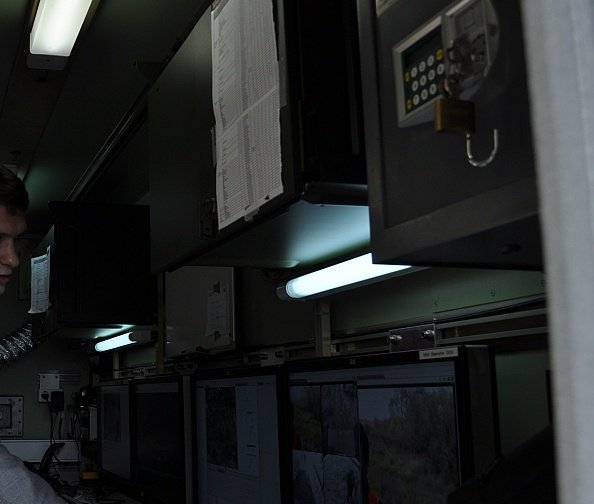
Where the correlation happens
Fusion can sit at three points, and which one a system uses determines what it can do when something goes wrong.
On the platform. Channels are combined before anything is transmitted. This cuts the link budget dramatically, which matters for mobile platforms whose radio is usually the binding limit. The cost is that the command centre never sees the raw returns and cannot re-examine a decision the platform already made.
At the command centre. Raw or lightly processed returns arrive from everything and are correlated centrally. This preserves the ability to look again, and it allows correlation across platforms rather than only within one. It costs bandwidth, and it concentrates the failure: the centre becomes the thing that must not go down.
In the operator. The default when neither of the above is built. It works, after a fashion, and it degrades in exactly the way people degrade — quickly, at night, and without anyone noticing until an event is missed.
| Channel | Detects | Fooled by |
|---|---|---|
| Thermal | apparent temperature contrast | crossover, wet surfaces, sun-warmed rock |
| Radar | motion and range | vegetation in wind, rain clutter, large animals |
| Seismic | ground vibration | livestock, vehicles on nearby roads, weather |
| Acoustic | sound signature | wind, traffic, aircraft overhead |
The third column is the reason the first exists. Fusion buys certainty in proportion to how independent the failure modes are: two channels fooled by the same wind agree confidently and wrongly, while a thermal contrast confirmed by a seismic trigger is unlikely to be vegetation.
This is also why adding a second camera is not fusion. Two channels running on the same physics share a blind spot, and a shared blind spot is not removed by averaging.
Why false alarms decide whether a system works
Specifications quote detection probability. Operations are decided by false-alarm rate, and the two are traded against each other by a threshold that someone has to set. Lower the threshold and the system detects more, including more of what is not there. Raise it and the night gets quiet, including the parts that should not have been.
The failure that false alarms produce is behavioural rather than technical. A channel that reports constantly trains the person watching to dismiss it, and the dismissal generalises. Nothing in the equipment records that this has happened, which is why published detection figures and operational usefulness can diverge for years without any measurement showing it.
What sensor fusion costs
- Time synchronisation across channels, without which correlation is guesswork
- Common geometry: every channel must agree where it is pointing, to a tolerance
- Processing on the platform, which is power, which is endurance
- Explainability: an operator has to be able to see why the system concluded what it did
The last is the one most often skipped in sensor fusion, and the one most consequential for who is answerable. A fused detection that cannot be taken apart, however few false alarms it produces, is a decision no person can check, and on a border every decision has to be attributable to someone.
Questions about sensor fusion
What is sensor fusion in border surveillance?
Combining returns from different sensor types so that one confirms or rejects another, instead of presenting each separately to an operator. A thermal contrast at a bearing, a radar track at the same bearing and a seismic trigger at the same time are one detection. Shown separately they are three alarms, and three alarms cost three decisions.
Why do false alarms matter more than detection rate?
Because an operator who stops trusting the system has switched it off without touching anything. A channel that reports a hundred times a night for one real crossing trains the person watching it to dismiss reports, and the one that mattered goes with the rest. Detection rate is a specification; false-alarm rate decides whether the specification is ever used.
Does sensor fusion reduce false alarms automatically?
Only if the channels fail independently. Two sensors that are fooled by the same thing — wind moving vegetation, a large animal, heavy rain — agree with each other and produce a confident wrong answer. Fusion buys certainty exactly to the extent that the physics behind each channel is different, which is why thermal, radar and seismic appear together and why two cameras do not count as fusion.
Where does fusion actually happen?
At three possible points: on the platform, at the command centre, or in the operator's head. The third is the default when the first two are not built, and it is the least reliable, because it depends on one person correlating several displays under time pressure at four in the morning.